

For the last few days, I have felt something that has been absent for a long time: hope.
Not the shallow, sparkly version of hope. Not the “everything will be fine” version, because I am not naïve and I have not suddenly forgotten what is happening in the world. There are still wars. There is still injustice. There are still people losing rights, safety and dignity because powerful people make decisions they will never personally have to live with. There is still cruelty being dressed up as policy, and hatred being presented as common sense.
But something has shifted.
What has been happening in America matters. Not because America is the centre of the universe — it absolutely is not — but because the political direction of the United States has consequences far beyond its borders. It affects the language that becomes acceptable. It affects which rights become negotiable. It affects who is protected and who is abandoned. It affects the confidence of extremists elsewhere, the policies that governments feel emboldened to copy, the stories people tell about democracy, and the futures ordinary people feel they are allowed to imagine.
There is a ripple effect. A butterfly effect.
When something moves in America, it is felt everywhere.
And over the past few days, I have felt that movement in myself. I have heard it in conversations with other people too. A little exhale. A little more energy. A little more willingness to imagine that things do not have to stay exactly as they are.
Not certainty. Not a guarantee. Not a magical solution to problems that have been decades — sometimes centuries — in the making.
Just possibility.
The reminder that people can still pay attention. People can still show up. People can still participate. People can still refuse to accept that the current reality is the only reality available to us.
Perhaps it has hit me harder because I am rewatching The Handmaid’s Tale while preparing to start another Margaret Atwood book. There is something profoundly unsettling about watching a story built around the gradual stripping-away of rights, autonomy and truth while watching real conversations unfold about who should be allowed a voice, whose choices are legitimate, and whose participation in democracy is somehow considered a threat.
Then, this morning, I saw a video of an older white MAGA man blaming women and young people for what happened in America a few days ago.
His argument, if you can even call it that, was that women and young people are the problem with democracy because they are “naïve.” That allowing women and young people to vote was somehow the worst thing that could have happened.
That word stayed with me: naïve.
Because calling women and young people naïve is not a serious political argument. It is a way to dismiss them without having to listen to them. It is a way of saying, “Your voice is inconvenient to me, so I will call you incapable of using it.”
It is what happens when someone looks at generations who have inherited instability, unaffordable housing, debt, climate crisis, shrinking rights, insecure work, war broadcast into their phones every day, and still decides they are too foolish to have a say in the future they will actually have to live in.
Women have heard versions of this for centuries. Too emotional. Too sensitive. Too irrational. Too inexperienced. Too easily influenced. Too much.
Young people hear a version of it too. You will understand when you are older. You do not know how the world works. You are idealistic. You are naïve.
But perhaps the real problem is not naïvety.
Perhaps the real problem is that women and young people are paying attention. Perhaps they are looking at the world as it is, not as some people remember it, romanticise it or need it to remain. Perhaps they have decided that they want something different.
And that is not naïve.
That is participation.
That is democracy.
That is hope.
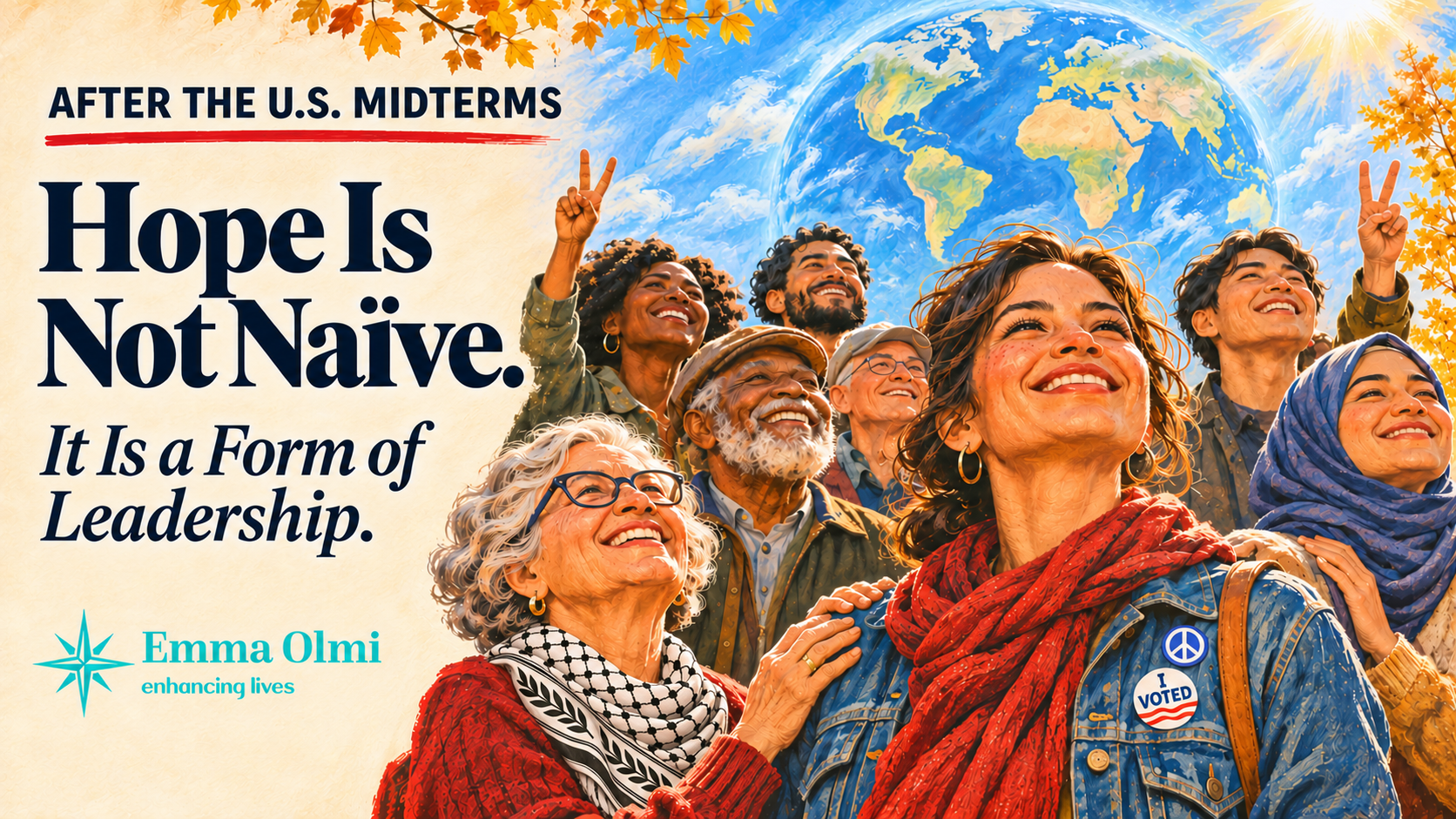
When leaders call people naïve
This is not only a political problem. It is a leadership problem too.
The language changes depending on the setting, but the tactic is familiar. In workplaces, communities and families, people who challenge the status quo are often dismissed rather than heard. They are called emotional, dramatic, difficult, oversensitive, inexperienced, unrealistic, disloyal or naïve.
It is much easier to label somebody than to engage with what they are saying.
If an employee says the workload is unsustainable, call them less resilient. If someone asks why promotion decisions are opaque, tell them they need to be more patient. If somebody points out discrimination, say they are creating a problem. If a younger colleague challenges a stale way of doing things, tell them they do not yet understand the real world.
The message is always the same: stay in your place, accept what you are being given, and stop making the people in charge uncomfortable.
That is not leadership.
That is control.
Good leadership does not require somebody to agree with you. It does not require every conversation to be easy. It requires the maturity to hear perspectives that challenge you, particularly when they come from people whose experiences are different from your own.
Bad leaders want compliance.
Real leaders can tolerate being questioned.
Real leaders understand that the people closest to a problem will often see things that those at the top cannot. They understand that experience matters, but so do fresh eyes. They understand that youth is not the same as ignorance, and that being emotional about something does not make it less true.
Most importantly, real leaders do not confuse their own comfort with everyone else’s wellbeing.
Nothing happens in a vacuum
I sometimes hear people say that they do not want to talk about politics because they “just want to focus on work.”
I understand the instinct. The world can be exhausting. We all need space to breathe, work, parent, rest, laugh, build things, love people and live our actual lives.
But politics does not politely stay outside the office.
It shows up in what people can afford. Whether they feel safe. Whether they can access healthcare. Whether they have control over their own bodies. Whether they can travel freely. Whether they feel accepted. Whether they are worried about family members abroad. Whether they are carrying grief, fear, anger or uncertainty into every meeting they attend.
It affects who gets hired, who gets believed, who gets promoted, who is expected to be grateful for less, who feels able to speak, who has energy to take risks, and who feels they need to stay silent in order to survive.
It affects the future people believe is available to their children.
So no, coaching, leadership, careers and wellbeing do not exist in neat little boxes, separate from the world outside. They are happening inside it.
You cannot ask people to bring their whole selves to work and then be surprised when they bring their values, their humanity, their fear, their grief, their anger and their hope too.
As a coach, I am not interested in turning every session into a political debate. My clients come to me with their lives: their careers, relationships, leadership challenges, confidence, wellbeing, ambitions and difficult decisions. But I will never pretend those lives are untouched by the wider world.
A person’s confidence is not created in a vacuum. Neither is burnout. Neither is their feeling of safety. Neither is their ability to leave a job, ask for more, make a decision, take a risk, or believe they deserve a different future.
We have to stop treating people as though they are individual projects, disconnected from the systems and circumstances around them.
Hope changes behaviour
One of the things I see again and again in coaching is what happens when people lose hope.
They do not always say, “I have lost hope.” It rarely sounds that dramatic.
It sounds like: “My manager is just like that.” “This is how my industry works.” “I have no options.” “I am too old.” “I am too late.” “I should just be grateful.” “There is no point trying.”
Sometimes those situations are genuinely difficult. Sometimes a workplace is toxic. Sometimes the system really is unfair. Sometimes leaving is not financially possible yet. I will never tell somebody that a few affirmations and a better mindset will remove real barriers. That is not coaching. That is avoidance.
But there is a difference between being realistic about barriers and accepting that you are powerless forever.
Something changes when a person can see even one inch of possibility again.
Not certainty. Not a guarantee that the application will lead to a job, the conversation will go perfectly, the leader will listen, the relationship will improve, or the world will become fair overnight.
Possibility.
Enough hope to update the CV. Enough hope to ask for support. Enough hope to say, “This is not working for me.” Enough hope to make a plan. Enough hope to protect a boundary. Enough hope to start the project. Enough hope to vote. Enough hope to have the difficult conversation. Enough hope to leave when the time is right. Enough hope to stay and fight for something better when that is what matters.
Hope is not passive. It is not sitting around waiting for somebody else to save us.
Hope changes behaviour because it makes action feel worthwhile.
And that is why it matters in leadership. It is not a nice extra. It is not a side effect that appears once the serious work is done.
Hope is part of how we lead.
A leader cannot control the world, and they should not pretend they can. They cannot promise that everything will be okay. But they can be honest. They can listen. They can create clarity where there is confusion. They can treat people as human beings rather than resources. They can make it safer to speak. They can refuse to normalise cruelty, fear and helplessness.
They can remind people — through their actions, not just their words — that their voice matters.
You are allowed to care about the world and your own life
I refuse the idea that caring about politics makes somebody unprofessional.
I refuse the idea that we have to choose between caring about injustice and focusing on our career; between looking after our wellbeing and paying attention to the world; between being values-led and being taken seriously; between building a life for ourselves and caring about the lives of others.
You can care about all of it.
You can want a promotion and care about the kind of workplace you are being promoted into. You can build a business and question the systems that make other people’s lives harder. You can want a healthier relationship, better boundaries, more rest and greater financial security while still caring deeply about democracy, rights, war, injustice and whose voices are being dismissed.
Those things are not competing priorities.
They are all part of being human.
The last few days have reminded me that hope can return quietly. Not because everything is fixed. It is not. Not because we can relax. We cannot. Not because one moment means the work is over.
But because people can surprise themselves. They can pay attention. They can show up. They can vote. They can speak. They can resist the idea that the present is permanent.
And every time somebody calls that naïve, I think perhaps they are not afraid of naïvety at all.
Perhaps they are afraid of people realising that they have more power than they were taught to believe.
Love, Light and Hope,
Emma