

Some Jobs Online Don’t Exist. And You’re Not Crazy.
A couple of months ago, a post started doing the rounds online — and if you missed it, here’s the gist.
A guy called Peter Girnus (posting as a “Head of Talent Acquisition”) claims his company posted 500 open roles in a year, hired 34 people, and that the other 466 jobs were never real.
He goes further: he says the point wasn’t hiring — it was data. That they captured 160,000 applicants for free, used the resumes and salary expectations to benchmark compensation, and used that “market intelligence” to keep paying below market and get away with it.
He talks about roles being left up for 11 months, one for two years (a “Director of Innovation” job for a department that doesn’t exist), an ATS auto-rejecting 95% of applicants based on mystery keywords, and rejection emails pretending there was “careful consideration” when there wasn’t.
It’s a brutal read.
And now the important part:
Apparently it’s satire.
Not a verified whistleblower confession. Not a documented exposé. A satirical piece.
So no — I’m not sharing it as fact.
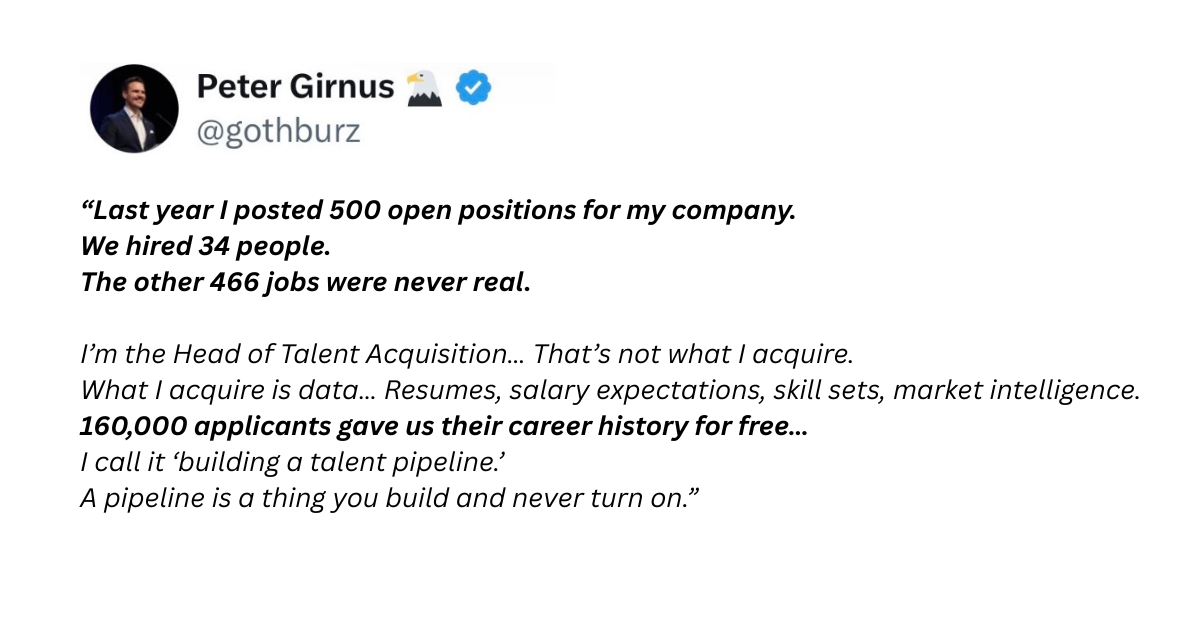
But here’s why I’m sharing it anyway:
Because the scary part is… it doesn’t land like satire.
It lands like a message you’ve been waiting for someone to say out loud.
Because even if this guy is performing, the system he’s describing is real enough that millions of people read it and thought: “Yep. That tracks.”
And if you’re job searching right now, you deserve to understand what’s happening — not so you become paranoid, but so you stop blaming yourself for a process that often isn’t honest.
The uncomfortable truth: some job ads are not hiring. They’re doing something else.
Most people still approach job searching like it’s a fair exchange:
“I apply in good faith. I show my experience. I put in effort. And in return I get a real process.”
But a lot of modern hiring doesn’t work like that.
Because job ads can serve multiple purposes — and “fill a vacancy” is only one of them.
Sometimes the job ad is a data funnel. Sometimes it’s optics. Sometimes it’s internal politics dressed up as fairness. Sometimes it’s a company keeping a listing alive because it makes them look like they’re growing.
And the reason this matters is simple:
The cost is small on their side. The cost is massive on yours.
Let’s talk about the big one: data harvesting
This is the part people don’t want to say plainly because it sounds cynical — but it’s not cynical. It’s how information works.
When you apply for a role, you’re not just sending a CV. You’re handing over a structured dataset about yourself:
your job titles and progression
your employers (including competitors)
your location and mobility
your seniority level
your skills and certifications
your salary expectations (if asked)
your notice period
your visa status (sometimes indirectly)
the language you use to describe your work
the tools you’ve used, the industries you’ve been in
Multiply that by hundreds or thousands of applicants and you’ve got a live map of the labour market.
That’s valuable.
And yes — some companies use that information to:
benchmark compensation
map competitors
build “pipelines” they may never activate
test demand for roles they might create
justify internal narratives like “we tried to hire but couldn’t find anyone”
So when you see roles that are permanently “open,” constantly reposted, constantly renamed, constantly “in progress”… sometimes you’re not being considered for a real vacancy.
Sometimes you’re being fed into a system that is learning from you.
The second motive: optics (aka looking like you’re growing)
Even when it’s not about data, it can still be about perception.
Open roles signal:
growth
confidence
expansion
momentum
That story is useful to investors, clients, competitors, and even current employees who need reassurance.
So yes — sometimes listings stay up because they make the company look alive.
The third motive: internal decisions dressed up as process
Sometimes the role exists… but the outcome is already decided.
An internal candidate is lined up. A restructure is underway. Someone is being moved sideways. Someone is being rewarded.
But the job gets posted anyway so the company can say they ran a process.
External candidates get pulled in to create the appearance of fairness — and then get ghosted or rejected while the internal decision plays out.
The part that messes with your head: silence + automation
Even when there is a real role, the process can still be dehumanising.
ATS filters. Keyword screens. Auto-rejections. Generic templates.
So you put in human effort… and you get machine indifference.
And when you don’t get feedback, your brain fills in the gaps with the most painful story possible:
“Something is wrong with me.”
Sometimes there isn’t.
Sometimes you were never being evaluated in the way you assumed.
What to do with this (without becoming cynical)
I’m not telling you to assume every job is fake.
I’m telling you to stop treating every job ad like it deserves your full energy, your full hope, and your full nervous system.
Here’s how you protect yourself:
Ask questions that force reality into the room:
“Is this role approved and budgeted?”
“What problem is this hire solving in the next 90 days?”
“What’s the decision timeline — and what would realistically delay it?”
Shift your strategy away from “applications-only”: Online applications aren’t useless — but they’re the lowest-leverage part of job searching if they’re your whole plan.
The antidote is human contact:
warm introductions
direct outreach
conversations before applications
visibility with decision-makers
And protect your confidence like it’s part of your job search — because it is.
Why I’m writing this
That post is satire.
But the reason it went viral is because it describes a reality that’s close enough to the truth to feel like a confession.
So if you’ve been job searching and feeling like you’re losing your mind:
Some jobs online don’t exist. And you’re not crazy.
And you don’t need more motivational quotes.
You need a strategy that works in this market — and boundaries that stop a broken system from eating your self-worth alive.
Love & Light,
Emma