Your Life Isn’t a Performance Review
Seems like everyone is talking about Stephen Bartlett’s “wine ruined three days” clip.
By the way — I don’t even drink, so this isn’t me taking sides in the alcohol debate, or trying to be clever about someone else’s choices.
What grabbed me about that clip isn’t the wine. It’s what it represents: a culture where every choice has to be measured, explained, optimised… and then judged. Where a normal human moment can turn into a three-day performance narrative.
And that’s what I actually want to talk about.
We’re living in a world where everything is automated, optimised, tracked, measured, and “improved.”
And somehow we’ve decided the logical next step is to do the same thing to ourselves.
Sleep score. Steps. HRV. Calories. Deep work blocks. Cold plunges. Morning routines. Evening routines. Supplements. “No alcohol.” “No carbs.” “No dopamine.” “No joy unless it’s earned.”
And the weirdest part?
A lot of this isn’t even about health anymore. It’s about virtue. It’s about being the kind of person who “has it together.” It’s about control. Certainty. Safety. Proof.
Because if you can measure it, you can manage it. And if you can manage it, you can stop feeling like life might swallow you whole.
That’s the seduction.
Optimisation doesn’t just promise results. It promises relief.
I love high performance. I coach high performers. I am one.
But I’m going to say the quiet part out loud:
Optimisation is useful until it replaces living. And high performance becomes toxic the moment you don’t know how to switch off.
Because at that point, you’re not building a better life. You’re building a better cage.
And it’s a cage you’ll defend, because it looks like discipline from the outside.
This is what I see in coaching, over and over: brilliant people who can run teams, build companies, manage crises, deliver under pressure… but can’t sit still on a Sunday without feeling guilty.
They don’t know how to be “off.” They don’t know how to rest without earning it. They don’t know how to enjoy something unless it’s productive, improving, or “worth it.”
So let me ask you a few questions that might be uncomfortable (good):
When did rest become a reward instead of a requirement?
When did fun become something you have to justify?
When did your body stop being your home and start being your project?
When did your life become a performance review you’re conducting on yourself?
And if you’re honest… who are you trying to impress?
Because if you can’t be “off,” you’re not high-performing.
You’re just permanently braced.
I just came back from a holiday with my little one, and I made a classic high-achiever mistake: I assumed I could “maximise” it.
Finland. Estonia. Latvia. Three countries in a week. On paper, it looked efficient. Impressive, even. The kind of itinerary that makes you feel like you’ve “done it properly.”
In real life? It started to feel like we were sprinting through beautiful places with a checklist in our hands.
Not even enjoying it properly — just collecting it.
And I know that impulse well. It’s the same impulse that shows up in work, in goals, in self-improvement: do more, fit more in, squeeze more out of it, don’t waste the opportunity.
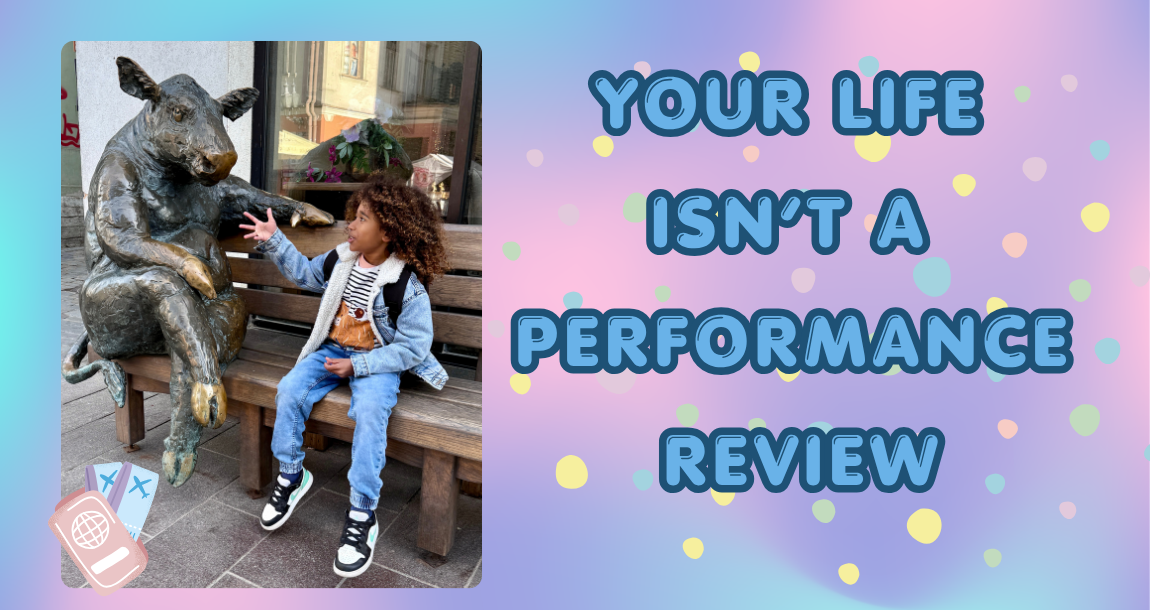
Then my son got really sick. Not “a bit under the weather” sick — I mean seconds from a toilet sick. Couldn’t eat. Vomiting. The kind of sick where you don’t negotiate with reality. You adapt.
So the plan died.
And our world shrank down to the basics: slow mornings, keeping him comfortable, and the only outing that felt safe — the playground next to a toilet, with vomit bags in my bag… just in case.
And I’m going to be honest: a part of me still tried to resist it.
Not because I didn’t care that he was sick — obviously I did. But because that high-achiever reflex is sneaky.
It whispers: you’re wasting the trip. You should be doing more. You’ll regret not making the most of it. Other people would handle this better. You can still squeeze something out of today.
That voice doesn’t sound like toxicity. It sounds like responsibility. It sounds like ambition. It sounds like being capable.
But it isn’t always wisdom.
Sometimes it’s just addiction to motion. Sometimes it’s fear of stillness. Sometimes it’s the inability to be present without turning the moment into a task.
And here’s the part that surprised me:
Those ended up being some of the best days of the trip.
Because the pressure disappeared. The performance ended. And we were allowed to just… be human.
No “we should be doing more.” No “we’re wasting time.” No “we’re not making the most of it.”
Just presence. Care. Simplicity. Enough.
That’s what optimisation culture forgets.
It sells you the idea that if you track everything, control everything, and squeeze every drop of potential out of every day… you’ll finally feel good.
But for a lot of people, it does the opposite.
It turns your life into a constant self-audit. It makes rest feel like failure. It makes fun feel irresponsible. It makes your body a project and your mind a workplace.
And then — quietly — it starts shrinking your life.
Because you stop doing things that don’t “count.” You stop seeing people unless it fits the routine. You stop taking the long way home. You stop wasting a day. You stop being spontaneous. You stop letting yourself be messy, human, unproductive, alive.
And I see this constantly in my coaching work: people who are brilliant, capable, ambitious… but they’re permanently at war with themselves.
They can’t switch off without guilt. They can’t slow down without panic. They can’t enjoy something unless it “counts.”
That’s not high performance. That’s compulsion dressed up as discipline.
So here’s a question worth asking:
If you can’t be “off,” what exactly are you performing for?
Because real high performance includes recovery. It includes seasons. It includes play. It includes relationships. It includes the ability to stop.
Not because you’ve earned it. Because you’re a human being, not a machine.
If this hit a nerve, you’re not broken. You’re not lazy. You’re not “undisciplined.”
You might just be tired of living like a machine in a world that keeps rewarding machine behaviour.
And if you want a different way to do ambition — one that includes recovery, joy, and a life you actually get to feel — you know where to find me.
(And yes: go do something nice today. Phones down. No tracking. No logging. Just living.)
Love & Light,
Emma