

I wasn’t supposed to be writing a blog this week. But Cristiano Ronaldo said goodbye to the Portuguese national team, and it has been on my mind ever since...
I listened to his farewell and cried. I played it for my son, Romeo, and he cried too. Every time I open social media, there seems to be another video of a child finding out, another little face crumpling as they realise their hero will never wear that shirt again.
As a Portuguese woman, it hurts. As a mother, watching those children is heartbreaking. And as a coach, I find myself thinking about what it takes to become someone whose example reaches so deeply into other people’s lives.
Because behind that influence are decades of discipline, perseverance and extraordinary hard work. The very qualities we encourage people to develop, then sometimes seem uncomfortable watching someone demonstrate so openly.
We tell people to believe in themselves. Then we call him arrogant.
This has frustrated me for years. People hear Ronaldo say he believes he is the best and decide that his confidence is the problem. I look at the career he has sustained and wonder how anyone could expect him to have built it without an enormous belief in himself.
A boy from modest beginnings in Madeira set himself an extraordinary ambition. Then he organised his life around the work required to pursue it. He kept doing that work through criticism, defeats, injuries, changing teams and the pressure of being watched by millions.
Consider the dedication that requires. To reach the top, then keep finding reasons to improve. To have achieved more than most people could imagine and still care enough to prepare, practise and compete. To experience failure publicly and return knowing that the next mistake will be scrutinised just as closely.
That is where grit becomes more demanding than the word makes it sound. We like talking about resilience when the story has reached its triumphant ending. Living through the uncertainty, disappointment and repetition is considerably harder.
In coaching, I see how quickly a setback can become a verdict. One rejection becomes “I’m not good enough.” A difficult presentation becomes “I’m not leadership material.” We begin negotiating down our ambitions to protect ourselves from having to feel that disappointment again.
Ronaldo has spent decades exposing himself to that possibility and continuing anyway. He has backed his ambition with sustained effort. Whatever someone thinks of his personality, that deserves recognition.
And I wish we would examine why such visible self-belief makes some people so uncomfortable. What are we teaching children when we tell them to dream big, then ridicule somebody for taking his own dream that seriously?
I have experienced his influence in almost 80 countries
There is another reason this feels personal. Ronaldo has been helping me around the world for years and we never even met.
There is a conversation I have had more times than I could possibly count, across almost 80 countries. Someone asks, “Where are you from?” I say, “Portugal,” and before I can say anything else, their face lights up. “Cristiano Ronaldo!” Sometimes it’s a delighted “Siuuu!” Sometimes both, followed by laughter, a goal celebration and suddenly a conversation with someone who, seconds earlier, was a complete stranger.
I would say it happens 99% of the time. It happened on my travels back in 2010, and it is still happening in 2026. Different countries, different languages, the same joyful reaction. His name has brought me warm welcomes, unexpected kindness and even meals that strangers insisted on paying for, simply because I come from the same country as their hero. He has been helping me around the world for years, without ever knowing I exist.
I have sat in restaurants where that familiar exchange, “Portugal? Cristiano Ronaldo!”, ended with the owner refusing to let me pay. Someone I had only just met wanted to offer me a meal because I came from the same country as a man they admired. That is how far his influence reaches. It changes how strangers treat other strangers.
And it has opened doors for me quite literally. In Shanghai, I once went to the wrong airport. By the time I reached the correct one, check-in had closed. I was desperately late, crying and convinced I had missed my flight. An airport worker took my passport, looked at it, looked at me and said, “Cristiano Ronaldo?” I answered, “Cristiano Ronaldo!” He smiled, said “Okay,” and let me through.
I caught that plane. To this day, I remember standing there trying to understand what had just happened. Thousands of miles from Portugal, his name had helped me through a door I thought was already closed.
How do you measure that kind of leadership and influence? What does it mean to inspire such affection that people extend it to someone they have never met, simply because she comes from your country?
Take a moment to consider the scale of that influence. A person develops such affection for a footballer that they extend generosity to a stranger from his country.
These experiences have repeated themselves across years of travelling. Governments spend fortunes promoting countries. Businesses spend fortunes trying to earn recognition and affection. I have watched Ronaldo’s name create an immediate human connection in places thousands of miles from Portugal.
How do you put a value on that? How do you measure the goodwill someone creates when it reaches people he will never know about?
Whatever the answer, I have been experiencing it for years. And he has absolutely no idea.
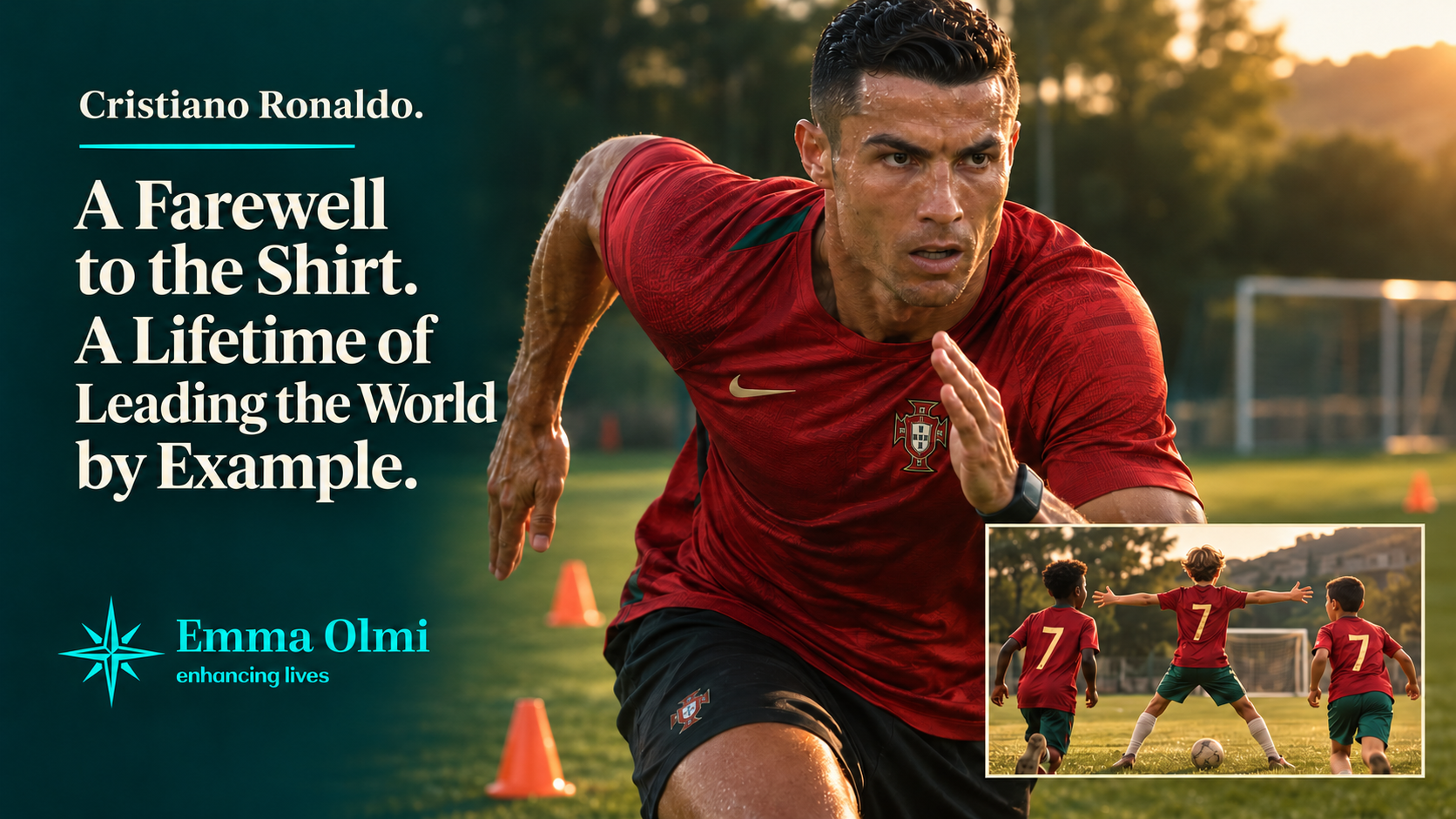
Look at the children
During the 2010 World Cup, I was staying in a little guesthouse in Cambodia. Portugal were playing at some ridiculous hour, around two in the morning, and I remember asking the women who worked there whether the television would still be on. Could I stay up and watch the match? There wasn’t another Portuguese person in sight, so I fully expected to be sitting there alone, cheering on my country while everyone else slept.
Instead, I found myself watching with a crowd of local children, teenagers and adults, people who worked or lived there, all staying awake to support Portugal. Because of Cristiano Ronaldo. Imagine that feeling. Thousands of miles from home, expecting to watch your team alone, and suddenly surrounded by people who wanted your country to win because they loved a man from Madeira. I still remember looking around that room in disbelief.
Sixteen years later, this summer, Romeo wanted to experience the World Cup surrounded by a big crowd, so we went to a packed venue here in UK to watch Portugal play. I will never forget our last match, the one we lost against Spain. Everywhere I looked, people were wearing Portugal shirts with Ronaldo’s name on the back, cheering for our team. At first, I assumed they were Portuguese. Then I realised the people around us came from all sorts of backgrounds, and they were supporting Portugal because of him. When we lost, I saw grown men crying. Romeo and I cried too, but this was our country, our team. To look around and see people with no Portuguese connection wearing our shirt and sharing that heartbreak, because Ronaldo’s World Cup dream was over, was something I will never forget. I had seen his name bring strangers together so many times on my travels. Here it was again, in London, with my son beside me, and I could see just how much it meant to them.
And just last week, I was in Algeria watching Romeo play football with local children in a playground. Every time somebody scored, the same celebration followed. “Siuuu!” Again and again. And this was Algeria, a country with its own proud football culture and a deep connection to Zinedine Zidane through his Algerian roots. Yet there were these children, celebrating their goals like Cristiano Ronaldo.
Those children in Cambodia will be adults now. The children playing with Romeo belong to another generation, growing up on another continent. And somehow, across all those years and all that distance, the same man has captured their imagination. That is the scale of the influence I’m talking about.
Siuuu!
More than a decade between those memories. Different children, different languages, different continents. The connection was immediate.
Children recognise something in him that makes them want to join in. They copy the celebration, wear the shirt and imagine themselves scoring the goal. For my son, there is also the pride of seeing someone Portuguese achieve something extraordinary.
That matters. We can tell children they have potential, but an example gives their imagination somewhere to go. Here is someone who came from a small island, began with very little and built a career recognised across the world. They can see what his effort became.
When Romeo cried at his farewell, I understood. This was someone who had become part of how he experienced football, Portugal and possibility. Watching so many other children react with that same sadness tells us something about the emotional connection Ronaldo has built.
There is a responsibility in being admired that deeply. There is also something profoundly moving about having given so many children a reason to believe they could become more than their current circumstances suggest.
He deserved a farewell worthy of what he gave
That is why I find the ending with the national team so painful. The disagreement, the public tension and the circumstances surrounding his departure have overshadowed a moment I wanted to see filled with appreciation.
I do not know every private conversation. My sadness does not depend on pretending that I do. I can recognise that team decisions are difficult and still feel that someone who gave so much deserved an ending with more dignity, unity and gratitude.
There is a leadership lesson here too. How we handle someone’s departure says a great deal about us. We can make decisions about the future while acknowledging what a person contributed to bringing us this far. People watching those departures draw conclusions about how their own years of commitment might one day be treated.
I wanted better for him. And I wish more of the conversation in Portugal recognised the full scale of what we are saying goodbye to.
The work, and what it made possible
Ronaldo’s career makes me think about the courage required to name an enormous ambition, the discipline to build towards it and the perseverance to continue when the experience becomes painful.
His influence makes me think about what can grow from that commitment. Children in Cambodia. Strangers in China. Generosity in restaurants. Football in Algeria. My own son, watching and believing.
Those connections began with a boy who believed in his future enough to work for it, year after year. They now belong to people across the world.
So yes, I admire his confidence. I admire the effort that sustained it even more. And I hope he knows that some of what he gave us will never appear in a record book.
I have carried a little of that generosity with me through almost 80 countries. Now I get to watch my son carry his own part of it forward.
Obrigada, Cristiano. Por tudo.
Love and truth, Emma