

If You Can’t Switch Off, You’re Not “Dedicated.” You’re Trapped.
This has been coming up in coaching for weeks — and this week it came up again, with four different clients. - and its only Tuesday morning.
Different industries. Different seniority. Different lives.
From CEO to team leaders.
Same sentence, basically word for word:
“I don’t want to check my work phone on holiday… but I’m scared not to.”
And I get it. Especially in Europe, where a “holiday” can actually mean three, four and even five weeks. That’s not a long weekend. That’s a proper disconnect.
So the anxiety makes sense — because what people are really saying isn’t “I love work too much to switch off.”
They’re saying:
“I don’t trust the system without me.”
“I don’t trust what I’ll come back to.”
“I don’t trust that people will respect my boundary.”
“I don’t trust myself not to cave.”
And underneath all of that is something even more uncomfortable:
A lot of high performers have been rewarded for being reachable. So now being unreachable feels… risky.
The Holiday Anxiety Nobody Admits
We talk about switching off like it’s a mindset thing. Like you just need to “relax.”
But most people aren’t failing to switch off because they’re dramatic.
They’re failing because they’ve never built the infrastructure for being off.
If you’ve trained people that you respond on holiday, they’ll keep messaging. Not because they’re evil — because you made it normal.
And if you’ve trained yourself that you’re the safety net, then silence doesn’t feel like rest.
It feels like danger.
Your Out-of-Office Isn’t a Boundary (Unless You Back It Up)
An OOO message is not a boundary. It’s an announcement.
A boundary is what happens after you announce it.
It’s whether:
someone else truly owns decisions while you’re away
your stakeholders know what “urgent” actually means
you’ve removed the bottlenecks that force people to wait for you
you’ve decided what you will and won’t do (and you stick to it)
Delegation Isn’t Optional If You Want a Life
Here’s what I’ve noticed: the clients who disconnect best aren’t necessarily the most senior.
They’re the ones who plan like adults.
They don’t just say, “I’m off next week.” They build a handover that makes their absence survivable.
A few things I’ve seen clients do really well lately:
1) They don’t “brief” — they transfer ownership
Not: “Can you keep an eye on this?” But: “You own this while I’m away.”
That one shift changes everything. It reduces the “I’ll just message you quickly” habit.
2) They pre-answer the predictable questions
They create a simple “if/then” list:
If X happens, do Y.
If it’s about Z, speak to A.
If it’s under £/€___, decide without me.
If it impacts the deadline, escalate to ___.
This is how you stop being the human bottleneck.
3) They manage expectations with the people most likely to test the boundary
They don’t send a fluffy OOO. They send a clear message before they leave.
Script you can steal:
“I’m offline from [date] to [date] and won’t be checking messages. If something is urgent, please contact [name]. If it can wait, I’ll respond when I’m back.”
No apology. No over-explaining. Just clarity.
How to Take a Real Break (Without the Guilt Hangover)
Here’s the part people don’t talk about enough:
Even with the best handover in the world, the first real disconnect can feel uncomfortable.
Because if you’re used to being “on,” switching off can trigger guilt, restlessness, even a weird sense of emptiness.
That doesn’t mean you’re doing it wrong.
It means you’re breaking a pattern.
The goal isn’t to feel perfectly relaxed on day one. The goal is to stop living like your nervous system is employed by your job.
The Missing Piece: Plan Your Return (So You Don’t “Check In” Early)
This is such a good point — and it’s one of the smartest things I’ve seen clients do recently.
A lot of people check email on holiday for one reason:
They’re trying to reduce the pain of coming back.
So instead of “white-knuckling” your way through a break, plan the return properly.
Here’s what that looks like:
1) Block your first day back
Not meetings. Not calls. Not “quick catch-ups.”
A protected block to:
scan what happened
respond to what matters
rebuild your mental map
If you don’t protect that time, your brain knows you’re coming back to chaos — and it will try to “pre-empt” it by checking early.
2) Create a “triage list” before you leave
Write down:
what you’ll ignore when you return (yes, really)
what you’ll respond to within 24 hours
what can wait 72 hours
what needs a meeting instead of an email spiral
This stops you from reopening the firehose the second you land.
3) Decide your re-entry pace
If you can, don’t come back to a full calendar on day one.
Even a half-day buffer changes everything.
Because the real flex isn’t “I answered emails from the beach.”
The real flex is returning without feeling like you need a holiday from your holiday.
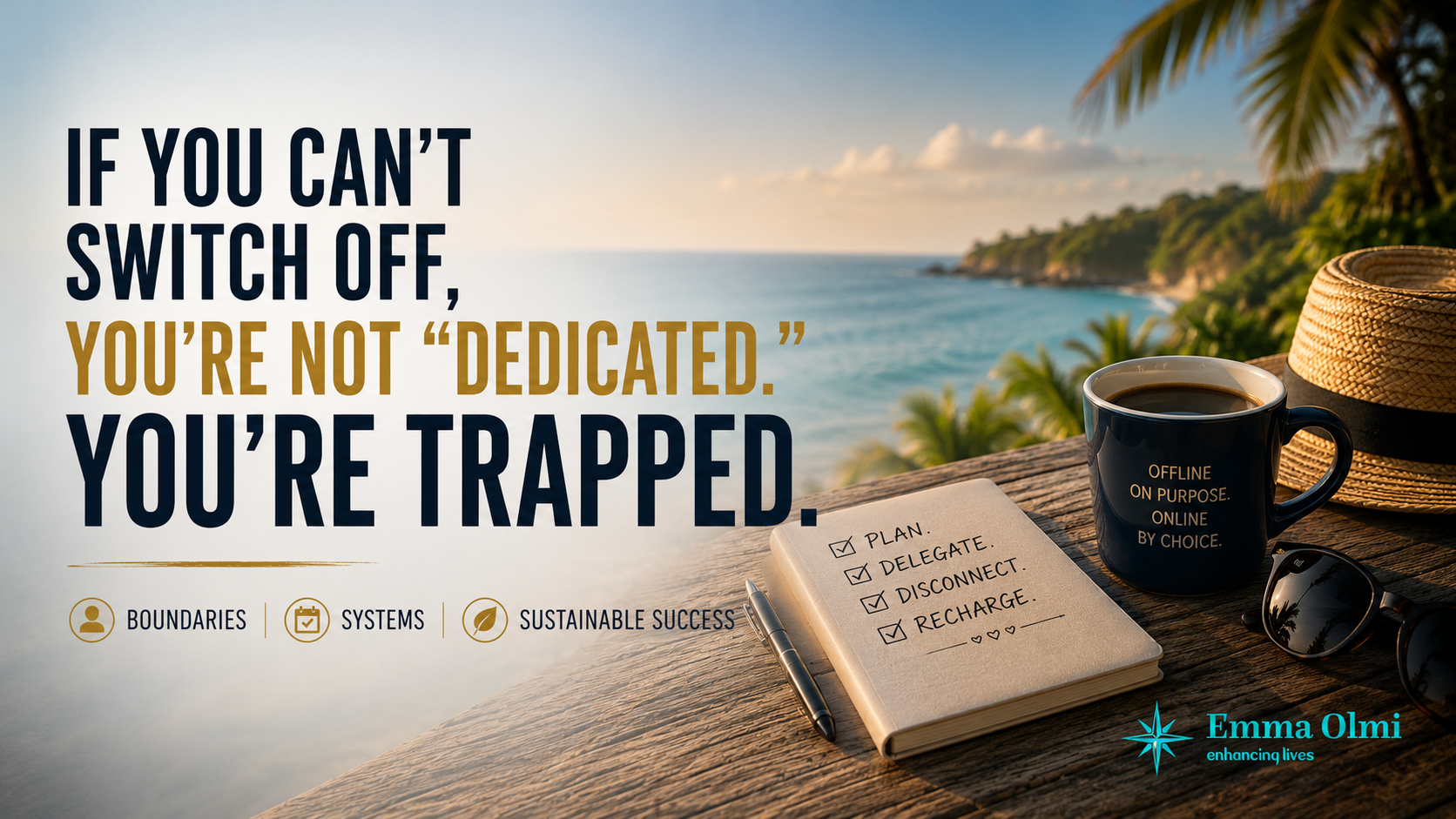
If You Can’t Switch Off, You’re Not “Dedicated.” You’re Trapped.
I’m not saying this to shame anyone.
I’m saying it because I coach too many brilliant people — at every level — who are exhausted, not because they don’t love their work, but because they can’t ever fully leave it.
And if you’re reading this thinking, “Yes, but my job genuinely needs me…”
Maybe.
Or maybe you’ve just been the solution for so long that nobody has had to build a better system.
A holiday isn’t a change of location with the same leash attached.
So if you’re going away this summer and you want to disconnect properly, start here:
Decide what “off” means
Transfer ownership, not tasks
Pre-answer predictable questions
Set expectations clearly
Block your return day
And then let yourself practise being unreachable.
Not because you don’t care. Because you do.
Love and Light,
Emma