

The Feedback Contract: How Great Managers Make Feedback Normal (Not a Shock)
One of the questions I ask in coaching — again and again — is simple:
“If work could be easier, what would you want more of?”
And the answer is almost always the same.
Not more money (though yes, obviously). Not fewer meetings (also yes). Not a better laptop.
More feedback.
People want to know where they stand. They want to know what’s working. They want to know what to stop doing before it becomes a “problem.” They want someone to say:
“You’re doing the right thing — keep going.”
“This bit is landing well.”
“This is the one thing that’s holding you back.”
“If you want to grow here, this is what needs to change.”
Instead, a lot of workplaces do this weird thing where feedback is treated like a rare event.
Like you have to earn it. Or like it’s dangerous. Or like it only counts if it’s saved up and delivered in a formal meeting once a quarter… or once a year.
So people go into their one-to-ones hoping for something real — and leave disappointed because they got “updates” and “status” and “all good!” and “keep doing what you’re doing!” (which is not feedback, it’s a polite dismissal).
Then review season arrives and suddenly it’s:
“Here are the things you should have known months ago.”
And managers act confused when people feel blindsided.
Let me be provocative and say the quiet part out loud:
Most people aren’t overwhelmed by feedback. They’re underfed.
And when you starve people of calibration, they don’t become resilient. They become anxious. They overthink. They guess. They people-please. They play politics. They overwork. Or they disengage.
Because humans can handle truth far better than they can handle ambiguity.
The real problem isn’t direct feedback. It’s surprise feedback.
I’m in favour of feedback in the moment. I’m in favour of directness. I’m in favour of managers saying the thing.
But here’s what makes feedback go wrong:
Not “straight away.” Not “honest.”
Unpredictable. Inconsistent. Random.
Feedback that only shows up when someone is annoyed. Feedback that’s delivered publicly to prove a point. Feedback that’s saved up like ammunition. Feedback that changes depending on the manager’s mood, stress level, or ego.
That’s not a feedback culture. That’s a nervous system problem.
So what do we do instead?
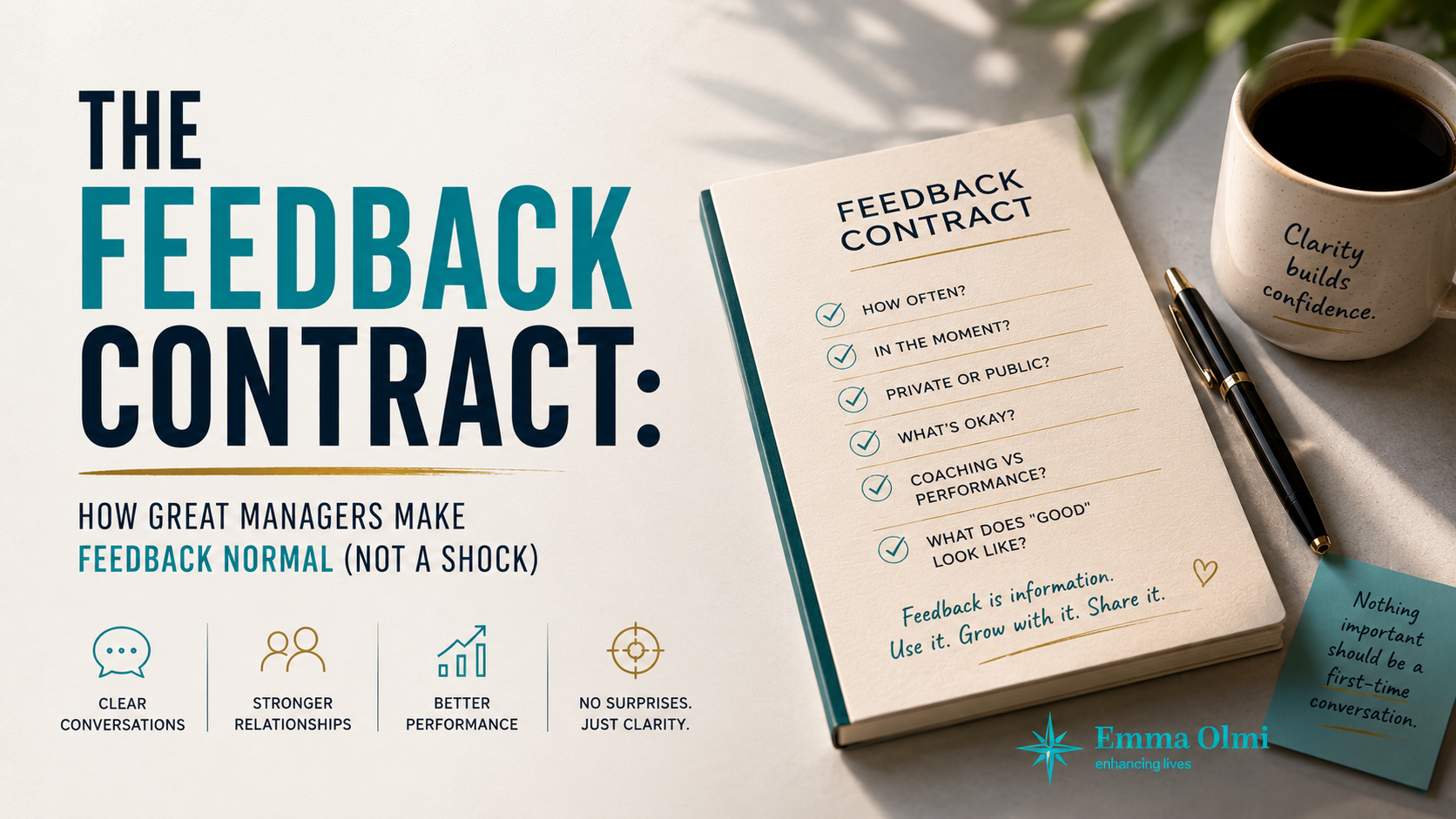
The Feedback Contract (the leadership skill nobody trains)
A feedback contract is an agreement between two humans at work:
How often do we give feedback?
Do we do it in the moment?
Do we do it privately?
Do we do it in writing?
What’s okay in public and what isn’t?
What’s coaching feedback vs performance feedback?
What does “good” actually look like?
When that contract exists, feedback stops feeling like a threat. It becomes what it should be: information you can use.
And yes — it makes immediate feedback easier, because it’s not a shock. It’s normal.
Stop mixing up the 3 types of feedback
A lot of managers think they’re “giving feedback,” but they’re mixing categories — and the other person is left guessing what the feedback means.
1) In-the-moment feedback (real-time)
Purpose: quick correction or reinforcement. Example: “Pause there — say that last sentence again, slower. It’ll land better.”
This is the most underrated kind because it prevents small issues becoming big ones.
2) Coaching feedback (pattern + growth)
Purpose: development over time. Example: “I’ve noticed you soften your point with apologies. Let’s change that pattern.”
This is where people grow — because it’s not about one moment, it’s about a habit.
3) Performance feedback (expectations + consequences)
Purpose: clarity on standards, outcomes, readiness for promotion, or gaps. Example: “This role requires X by Y date. Right now we’re at Z. Here’s what needs to change and by when.”
This one must be explicit. Vague performance feedback is how people get quietly set up to fail.
Different people, different feedback (and that’s not “being soft”)
Tailoring feedback isn’t walking on eggshells. It’s competence.
Here are four styles leaders can consciously choose from:
Style A: Direct + fast
Good for quick adjustments. Risk: can feel harsh without trust.
Style B: Direct + private
Good for dignity + clarity. Risk: managers delay it and then it becomes “a thing.”
Style C: Reflective + collaborative
Good for ownership and coaching. Risk: can become vague if you never land the point.
Style D: Written + structured
Good for clarity, remote teams, neurodiversity, complex feedback. Risk: tone can be misread if it’s emotionally loaded.
None is “best.” The skill is matching the style to the person and the moment.
The “no surprises” rule
If you want feedback to be normal and useful, adopt one rule:
Nothing important should be a first-time conversation.
If someone is doing well — tell them before they burn out trying to prove it. If someone is off-track — tell them early enough to fix it. If someone is promotion-ready — don’t make them guess.
Because the cruelest thing at work isn’t direct feedback.
It’s silence.
A Feedback Contract you can steal (manager + employee)
In your next 1:1, try:
“Do you prefer feedback in the moment, or in our 1:1?”
“Do you want it blunt and quick, or with context?”
“What’s a hard no for you? (public feedback, Slack, end-of-day dumps?)”
“If I need to correct something quickly, can I do that in real time?”
“If you’re unsure where you stand, how do you want to raise it?”
And if you’re not the manager, you can still lead upward:
“Can we agree how you like to give feedback, so I’m not guessing?”
“I’d rather know early than later.”
“What does ‘good’ look like in this role — specifically?”
That’s not neediness. That’s professionalism.
If you take one thing from this
People don’t need less feedback.
They need more feedback — delivered in a way that’s predictable, calibrated, and usable.
Because clarity builds confidence. And guessing builds anxiety.
Emma